Insights
A look at the application.
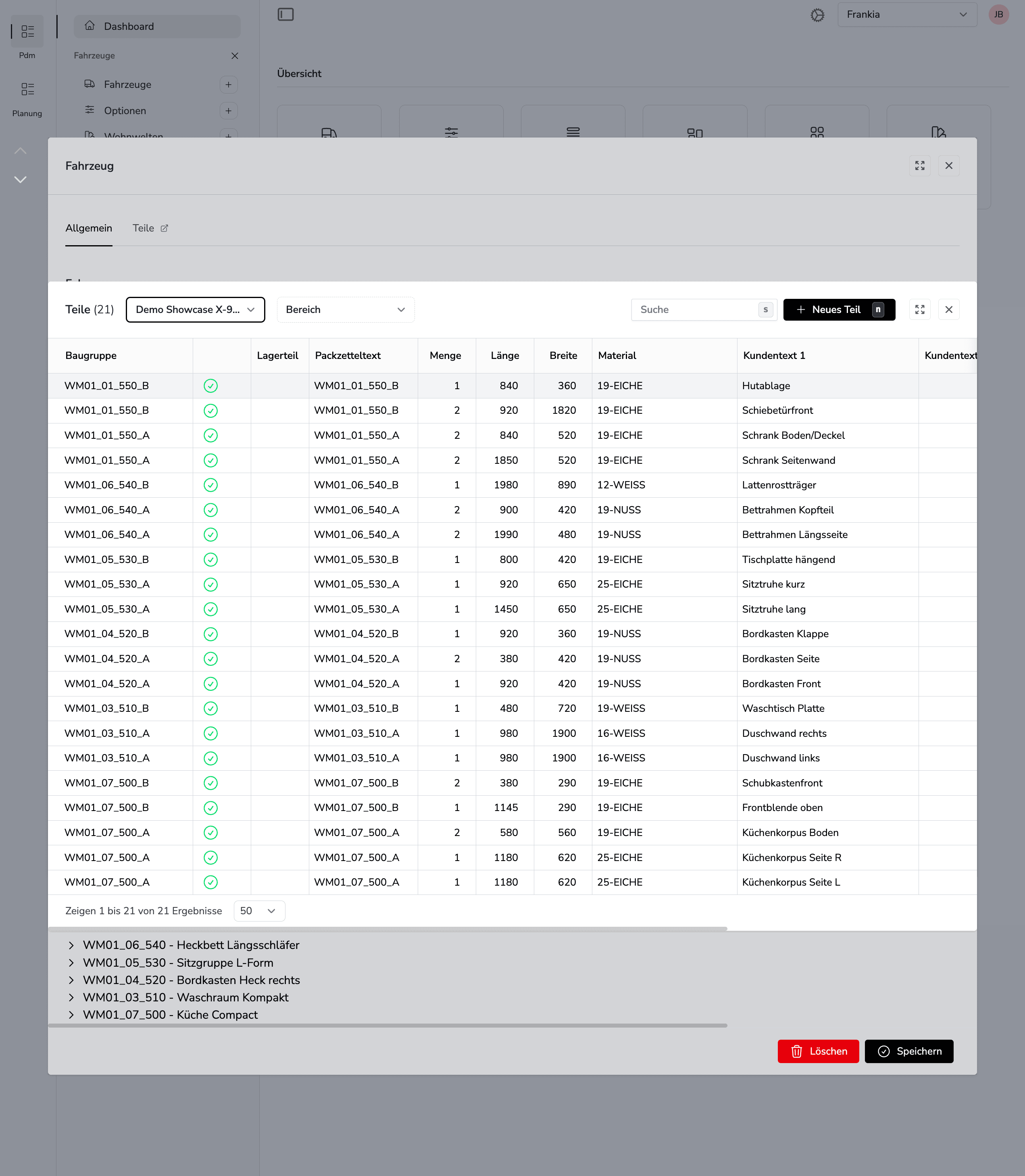
Two tightly integrated web applications that cover the entire path from product definition to scheduled production — rule-based, traceable and scalable across hundreds of vehicle variants.
A motorhome model can be built in countless configurations — floorplans, equipment, chassis variants, materials, custom requests. Every option changes which parts must be built in which quantity.
Classic static bills of materials hit their limits in the face of this variety. Maintenance and updates became increasingly manual, error-prone and hard to trace — with corresponding risks for quality, lead time and material planning.
In the first module, vehicles, options, assemblies and materials are maintained centrally. An integrated rule logic describes which part is installed in which quantity under which conditions — configured once, effective for all future variants.
The second module turns this into concrete production runs: schedule vehicles, choose individual options — the system automatically derives the matching, production-ready parts list. The result: ready-to-use planning instead of manual assembly.
Vehicle types, options and assemblies are maintained in one place — structured, hierarchical and traceable. New equipment can be added by configuration, not code changes.
Parts are tied to conditions rather than stored as separate BOMs per variant. Inclusions, exclusions and variable quantities are decided automatically based on the chosen options.
Materials and decors are bundled into groups. Individual substitutions per variant are possible without duplicating entire BOMs — and remain fully traceable afterwards.
Regular and short-notice spare-parts runs, vehicles with individual option choices, specialized exports for the different manufacturing areas — as a basis for workshop and supply chain.
What used to be assembled in extensive, manually maintained Excel sheets now appears at the press of a button. The rule logic ensures that for every option combination, the right parts are pulled in the right quantity automatically — without maintaining BOMs per variant.
Versioning and continuous data management ensure plannings can be audited at any time, while spare-parts runs enable fast response to short-notice changes. For the manufacturer this means: fewer errors, better overview and traceability — and a system that grows with new requirements rather than slowing them down.
Hundreds
variants from one base model — by configuration
2
modules — one continuous data flow
A few clicks
from configuration to a production-ready parts list
Step 1 of 3
June 2026
No appointments available this month. Please try a different month.